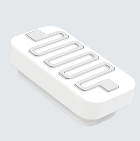
Introduction: A multi-state operator needs one hardware decision to serve many state menus, and rechargeable dual-chamber empty hardware can simplify that decision by delivering two independent units inside a single SKU.
Multi-state product planning creates a familiar squeeze: state menus drift apart, retail accounts want their own flavor stories, and every new SKU adds a filling changeover, a carton count, and a shelf slot. A rechargeable dual-chamber platform can lighten that load because the two chambers are not one device with two compartments. They are two independent units held together by magnets, with separate batteries, charging ports, airways, and fills.
Single-state brands may treat empty hardware as packaging. Multi-state operations need it to perform as a planning tool, because the platform decides how many filling setups you run, how many SKUs each state warehouse carries, and how quickly you can answer a shift in demand. Choose a device with one battery and one airway, and every flavor pair becomes two products, two boxes, and two inventory lines. Choose a platform where the chambers operate independently, and a state menu item can be a matched pair sold as one unit. That independence is the practical difference. Each chamber in The Twins carries its own 180mAh Grade A lithium battery and its own Type-C charging port, so the two halves charge independently. If a customer uses one chamber more heavily, the other half is not tied to the same cell. This turns dual-chamber hardware into a planning tool: you can combine two profiles without tying their performance together, and you can change one fill in a state menu without pulling the whole unit. Rechargeability also changes the commercial window. A device that can be topped up between sessions fits accounts where customers expect to keep hardware in rotation, and it positions the product as a device rather than a single-use item. Dual Type-C ports match the cable standard buyers already use. The USB-IF specification defines the Type-C connector, so one compatible cable can serve both units without a dedicated charger in the box. Runtime, charge time, and charger compatibility depend on the oil, usage pattern, and charging setup, so confirm those points during sampling. Aimvape builds this format as The Twins: empty hardware with a magnetic 2-in-1 body, dual independent 180mAh Grade A lithium batteries, dual Type-C independent charging ports, a postless transparent tank, dual independent airways, 1mL × 2 capacity, and inhale activation. It ships with no oil and no charger, so licensed fillers can add their own oil, branding, and packaging for each state program.
The useful way to plan this hardware is to treat it as a pairing tool rather than a fixed product. Four combinations cover most of what a multi-state portfolio asks for:
Each combination depends on the chambers behaving as separate systems. Dual independent airways separate the two flavor paths, which supports flavor purity between fills. The postless transparent tank shows oil level from any angle, so a customer can see which half is running low. The 8.6mm body keeps the pair pocketable, and the magnet lets a consumer split the unit to share one half and keep the other. At retail, staff can separate the halves for demonstration and show that each half works on its own. This is also where a multi-state product line gains operating room: a state with strong demand for premium extracts can lead with the tier-pair story, while a value-focused market can use duplicate fills or a core-plus-limited pair without changing the hardware platform. The portfolio stays coherent because the format stays consistent, even when the oil strategy changes by state.
A sample request is more useful when it carries your state plan. Before you ask for units, write down which states you are launching, which oil viscosities you fill, whether you need state-specific packaging or one colorway across the portfolio, and whether your retail partners want the pair merchandised as a set. That information shapes capacity selection and carton artwork, and it can save a round of samples. If your roadmap reaches beyond the US, start the electrical compliance review early. The EU's EMC Directive sets the framework for electronic hardware sold in that market; use it as background and confirm certification status with Aimvape for your target market. When samples arrive, run them the way your accounts will. Fill both chambers with your own oil, charge the units the way a customer would at home, and hand them to two or three retail partners for a week. Watch how the two halves behave on separate charge cycles, whether the magnetic connection holds after repeated splits, and whether the oil level stays readable. A dual-unit product earns shelf space only when each half works as a complete unit. The FTC's advertising guidance puts the focus on substantiating performance claims, so keep retail copy on structural facts the hardware delivers: separate airways, separate batteries, and a visible oil level. Then turn to the commercial side. Color, logo placement, surface finish, and packaging sit inside the AIM Crafted Service scope, and the standard configuration is 1mL × 2 per unit. As a custom disposable vape manufacturer, Aimvape confirms project terms by email. Send your state mix, oil viscosity, packaging direction, and target volumes to info@aimvape. com; the sample and configuration guidance you receive will be built around the portfolio you plan to ship.
Rechargeable dual-chamber hardware earns its place in a multi-state portfolio when it reduces the number of moving parts, not when it adds a gimmick. Two independent batteries and two Type-C ports mean the chambers can be filled, charged, and managed separately while still selling as one unit, which is the flexibility a state-by-state menu demands. Aimvape has delivered more than 300 million devices to North American brands since 2016 and builds this format for fillers who need that flexibility on the shelf. If the model fits your roadmap, request samples with your state mix attached and start the configuration conversation from real portfolio numbers.
A: Because a state menu item can be built as a matched pair on one platform instead of two separate devices. Each chamber has its own battery, charging port, and airway, so you can pair a premium oil with a core oil, or a core SKU with a limited release, without tying the two halves together in filling, inventory, or performance. That can keep SKU counts, tooling, and warehouse exposure lower as you enter each new state.
A: Dual Type-C ports and two 180mAh Grade A batteries let each half operate as its own unit. One chamber can be in use while the other charges, and a customer who finishes one fill is not left with a dead device. In planning terms, this supports pairing oils from different price tiers and lets retail staff present the product as two usable units in one body.
A: Bring your state launch list, oil viscosities, capacity target, packaging and colorway plan, and expected volumes, since those drive the configuration. Confirm how the empty hardware will be filled on your line, how the magnetic connection should hold through retail handling, and which custom options fit your launch window. Sample quantities, project terms, and lead time come back by email from the factory.
USB Type-C Cable and Connector Specification Release 2.5
Electromagnetic Compatibility Directive
Advertising and Marketing | Federal Trade Commission