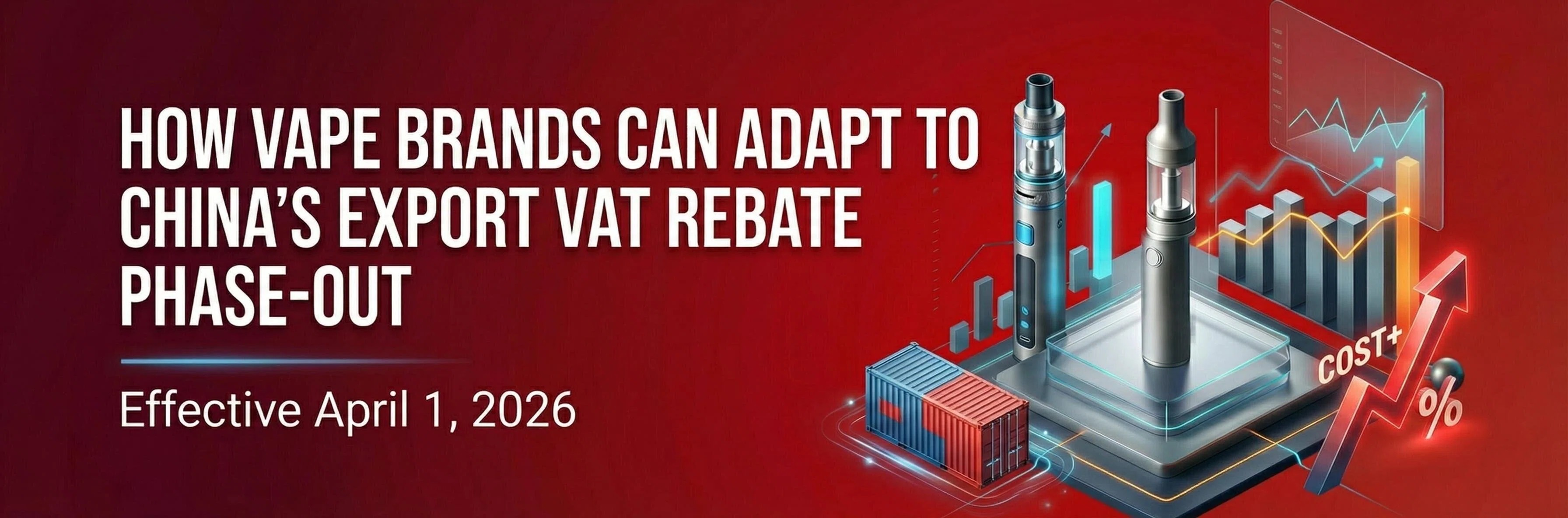
Operating a successful business is a continuous exercise in adaptation. Each industry grapples with unique challenges, from market volatility and supply chain complexities to evolving regulatory frameworks. For the global cannabis vape industry, a significant policy change is on the horizon that will reshape cost structures and competitive dynamics. The Chinese government is phasing out its long-standing Value-Added Tax (VAT) export rebate, a move set to directly impact over 90% of the market reliant on Chinese manufacturing.
Understanding the Value-Added Tax (VAT) and the Rebate SystemImplemented in 1985, China's Value-Added Tax is a consumption levy applied at each stage of production and distribution. Unlike a sales tax applied only at the final point of purchase, VAT is collected incrementally as value is added to a product along the supply chain.
For decades, an Export VAT Rebate system served as a key incentive for Chinese manufacturers. It refunded the VAT paid on exported goods, effectively reducing their final cost and boosting China's competitiveness in global markets. For many vape hardware products (devices, batteries, etc.),
this rebate was typically 13%. This mechanism became deeply embedded in pricing models, allowing brands to source high-quality hardware at notably lower costs.
The Turning Point: What Changes in 2026Beginning in 2026, China initiated a phased elimination of these VAT rebates for a broad range of products, explicitly including vape hardware and key components like lithium-ion batteries. This is not a targeted measure against the vape industry but part of a macroeconomic strategy. The policy shift signals the end of an era of direct export subsidies, requiring businesses to fundamentally reassess their pricing, budgeting, and supply chain strategies.
Assessing the Impact: Who Feels It Most and How Much?While all brands sourcing from China will be affected, the severity will vary:
- Most Vulnerable: Brands that depend heavily on export-only OEM/ODM manufacturers, operate with very thin hardware margins, or specialize in high-volume, low-margin SKUs will face immediate pressure.
- Also at Risk: Companies with long inventory cycles, limited supplier diversification, or fixed retail pricing contracts will struggle to absorb the sudden cost increase smoothly.
In concrete terms, the financial impact is substantial. A vaping device previously costing a brand $2 at the factory gate could see its cost rise to approximately $2.16 to $2.26 after the full rebate removal. This 8-13% increase compounds dramatically across large orders, making proactive financial planning essential.
- A Crucial Clarification: This policy does not mean the end of Chinese vape manufacturing. China remains the global leader in hardware production, quality, and scale. The phase-out simply alters the cost foundation, urging a transition from a subsidy-reliant model to one reflecting true production and value.
The "Why": China's Strategic Policy EvolutionThis move aligns with China's broader economic goals: to upgrade its manufacturing sector, encourage higher value-added and innovative production, and foster stronger domestic consumption. By gradually removing generalized export subsidies, the policy incentivizes manufacturers to move up the value chain—focusing on advanced technology, proprietary design, and sustainable practices—rather than competing solely on subsidized cost.
Strategic Responses for Vape BrandsTo navigate this transition successfully, brands must act strategically and proactively:
- Conduct a Supply Chain Audit: Immediately identify all hardware components and finished products affected by the rebate phase-out. Map your entire supply chain to understand exposure.
- Revise Financial Models: Update budgets and forecasts to account for the 8-15% cost increase. Model different scenarios based on order volumes and product categories.
- Engage Suppliers Proactively: Initiate transparent conversations with manufacturing partners. Confirm new ex-factory prices , minimum order quantities (MOQs), and production timelines. Explore opportunities for joint efficiency improvements.
- Optimize Inventory Management: Plan inventory purchases strategically to buffer against transition-period disruptions or price volatility, but avoid overstocking that ties up excessive capital.
- Re-evaluate Pricing and Product Strategy: Assess the need for retail price adjustments, product bundle redesign, or a strategic shift toward higher-margin segments to protect profitability.
- Explore Diversification: While China remains a primary hub, investigate alternative sourcing regions for certain components to build long-term supply chain resilience and bargaining power.
Looking Ahead: Turning Challenge into OpportunityThe VAT rebate phase-out is a pivotal moment for the vape industry. While it presents undeniable short-term cost challenges, it also pushes brands toward greater operational maturity. By forcing a reevaluation of supply chains, cost structures, and value propositions, this shift can drive innovation, stronger supplier partnerships, and more sustainable business models. Brands that start planning now, with clarity and strategic foresight, will not only weather the change but can emerge more robust and competitive in the evolving global landscape.


